
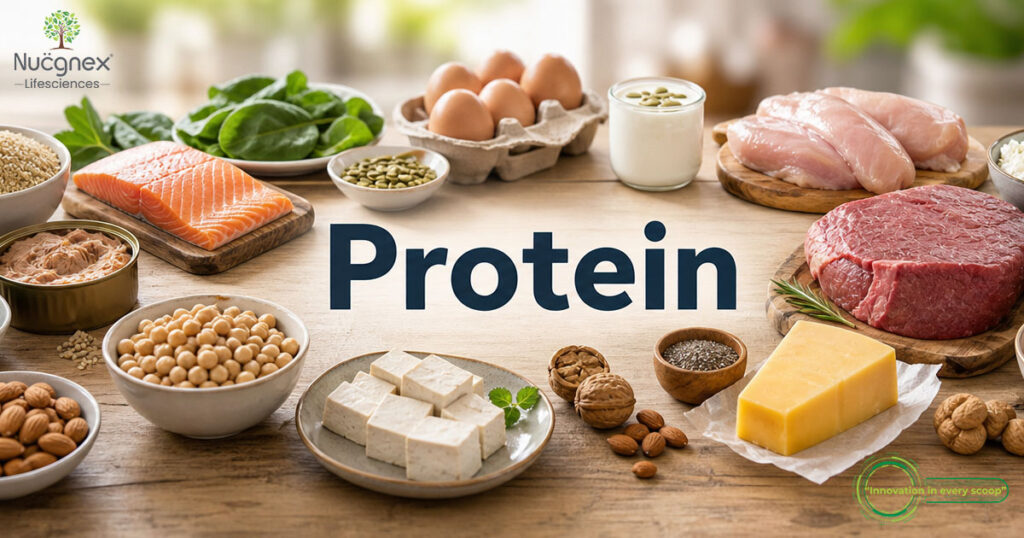
Why Protein Matters in Health and Illness:
Protein is the only macronutrient the body cannot store in a dedicated reserve, which is why a steady daily supply matters in health and in illness. Every enzyme, antibody, muscle fibre and hormone receptor is built from it. When intake falls short, the body breaks down its own muscle to meet demand.
Yet protein is often discussed only in gym or diet terms. In clinical practice, it is a therapeutic tool: it shapes recovery after surgery, survival in the ICU, growth in infants and independence in older adults. This article traces protein end to end: where it comes from, how it is classified and manufactured, which countries produce it, and how it is used in clinical nutrition and formula feeds.
Understanding protein and how its quality is measured?
Proteins are chains of 20 amino acids. Nine are essential, meaning the body cannot make them and they must come from food: histidine, isoleucine, leucine, lysine, methionine, phenylalanine, threonine, tryptophan and valine. Others, such as glutamine and arginine, become conditionally essential during severe illness, burns or trauma, when demand exceeds the body’s capacity to synthesise them.
Not all protein is equal. Quality depends on two things: the essential amino acid profile, and how much of it the gut actually absorbs. Two scoring systems are used:
- PDCAAS (Protein Digestibility Corrected Amino Acid Score), adopted by FAO/WHO in 1991, scores proteins from 0 to 1.0. Scores above 1.0 are truncated, which hides differences between high-quality proteins.
- DIAAS (Digestible Indispensable Amino Acid Score), recommended by the FAO Expert Consultation in 2013, measures digestibility at the end of the small intestine (ileum) for each amino acid. It is not truncated and is considered more accurate.
Under DIAAS, milk proteins, eggs and meat generally score at or above 100, soy isolate scores in the high 80s to 90s, and most cereal and pulse proteins score lower because they are limited in lysine (cereals) or sulphur amino acids (pulses). This is why Indian dietary tradition of combining dal with rice or roti makes nutritional sense: the two proteins complement each other.
Leucine deserves special mention. It acts as a signal that switches on muscle protein synthesis via the mTOR pathway. Proteins rich in leucine, such as whey protein, are therefore preferred when the goal is preserving or rebuilding muscle.
Sources of protein
Dietary protein comes from three broad groups: animal, plant and emerging sources. Each differs in protein density, amino acid completeness and digestibility.
| Source | Approx. protein (g per 100 g) | Complete protein? | Notes |
|---|---|---|---|
| Whey protein isolate | 85–90 | Yes | Highest leucine; fast absorbing |
| Soy protein isolate | ~90 | Yes | Best-studied plant protein |
| Chicken breast (cooked) | ~31 | Yes | Lean, widely consumed |
| Paneer | ~18 | Yes | Key vegetarian source in India |
| Egg (whole) | ~13 | Yes | Reference protein in many studies |
| Lentils / dal (dry) | 22–25 | No (low methionine) | Staple Indian source |
| Peanuts | ~26 | No (low lysine) | Also high in fat |
| Cow milk | ~3.3 | Yes | 80% casein, 20% whey |
| Rice (raw) | ~7 | No (low lysine) | Major contributor by volume in Indian diets |
Values are approximate and drawn from the ICMR-NIN Indian Food Composition Tables (2017) and USDA FoodData Central.
Animal sources (milk, eggs, meat, fish) provide complete proteins with high digestibility. Dairy is the backbone of medical nutrition because it is safe, well tolerated and easy to fractionate.
Plant sources (pulses, soy, cereals, nuts, seeds) are more sustainable and suit vegetarian populations, but individual plant proteins are usually incomplete. Blends, such as pea with rice, close the gap.
Emerging sources include mycoprotein (fungal fermentation), microalgae such as spirulina, insect protein and precision-fermented dairy proteins. These are growing commercially but have limited clinical evidence so far.
Types of protein used in nutrition products
Nutrition formulators choose a protein form based on the patient’s digestive capacity, allergy risk and the clinical goal.
| Protein form | Protein content | Absorption | Typical clinical use |
|---|---|---|---|
| Whey concentrate (WPC) | 35–80% | Fast | General supplementation, sports and recovery |
| Whey isolate (WPI) | ≥90% | Fast; minimal lactose | Lactose-sensitive patients, muscle preservation |
| Casein / caseinates | ~90% | Slow; clots in stomach | Sustained amino acid release, night-time feeds |
| Milk protein concentrate | 70–85% | Mixed fast and slow | Balanced standard formulas |
| Soy / pea isolate | 80–90% | Moderate | Vegetarian, vegan or cow-milk-avoiding patients |
| Hydrolysed protein (peptides) | Varies | Very fast | Malabsorption, pancreatitis, feed intolerance, cow’s milk allergy |
| Free amino acids | 100% as amino acids | Direct | Severe allergy, short bowel, metabolic disorders |
| Goat milk protein | ~3.1% in milk | Softer curd | Paediatric and sensitive-gut nutrition |
The fast versus slow distinction was demonstrated by Boirie and colleagues (1997): whey produced a rapid, high rise in blood amino acids, while casein gave a slower, prolonged release. Later studies in older adults found whey stimulated muscle protein synthesis more than casein at equal doses, largely due to its leucine content and speed (Pennings et al., 2011).
Hydrolysates are proteins pre-digested by enzymes into short peptides. They are absorbed through dedicated peptide transporters (PepT1) in the gut, which remain functional even when intestinal function is compromised. Extensively hydrolysed formulas are a first-line option for infants with cow’s milk protein allergy, and amino-acid formulas are used when hydrolysates are not tolerated.
Goat milk protein is gaining attention because it forms a softer, looser curd in the stomach than cow milk and contains lower levels of alpha-s1 casein. The European Food Safety Authority (EFSA, 2012) concluded that goat milk protein is suitable as a protein source for infant and follow-on formulas.
Where the world’s protein comes from
Global protein supply is concentrated in a handful of countries, and India leads in two of the most important categories: milk and pulses.
| Protein commodity | Leading producers | India’s position |
|---|---|---|
| Milk | India, USA, Pakistan, China, Brazil | No. 1; about 239 million tonnes in 2023–24, roughly a quarter of world output |
| Pulses | India, Canada, China, Myanmar | No. 1 producer and consumer, about 25% of global production |
| Soybean | Brazil, USA, Argentina | Around 5th; mainly Madhya Pradesh and Maharashtra |
| Eggs | China, India, USA | No. 2; over 140 billion eggs a year |
| Meat | China, USA, Brazil | Large buffalo meat exporter, lower domestic consumption |
| Whey and milk protein ingredients | EU, USA, New Zealand | Growing, but India still imports much of its high-grade whey isolate |
Approximate figures from FAOSTAT and the Government of India’s Basic Animal Husbandry Statistics; confirm the latest year before publishing.
This creates an interesting gap. India produces more milk than any other country, yet much of it is consumed as liquid milk, ghee and paneer. Industrial fractionation into whey isolates and milk protein concentrates is still concentrated in Europe, the USA and New Zealand, so many Indian clinical formulas depend on imported protein ingredients. Building domestic capacity for high-grade dairy protein is one of the more important opportunities in Indian nutrition manufacturing.
Ever wondered how protein is made?
Protein ingredients are not synthesised from scratch. They are separated and concentrated from milk, plants or microbes using physical, enzymatic and fermentation processes.
1. Dairy protein: from milk to whey and casein
- Milk is pasteurised and skimmed to remove fat.
- Casein is separated, either by adding rennet (as in cheese making) or acid, which makes casein coagulate. The remaining liquid is whey.
- Whey is clarified and passed through membranes. Ultrafiltration concentrates protein into WPC; microfiltration or ion exchange removes more lactose and fat to produce WPI.
- The liquid concentrate is spray-dried into powder.
For medical use, the protein may be treated with enzymes to produce hydrolysates, then dried again.
2. Plant protein: soy and pea isolates
Seeds are dehulled and milled into flour. Protein is dissolved at an alkaline pH, the fibre and starch are separated, and the protein is then precipitated at its isoelectric point (around pH 4.5 for soy). The curd is neutralised, washed and spray-dried. Pea protein follows a similar wet-extraction process.
3. Fermentation-derived protein
Mycoprotein is grown from the fungus Fusarium venenatum in large fermenters. Precision fermentation uses engineered yeast or fungi to produce specific proteins, such as beta-lactoglobulin identical to dairy whey, without animals. Free amino acids for medical formulas are also produced mainly by bacterial fermentation.
4. Quality control for clinical use
Medical-grade protein must meet strict limits for microbial load, heavy metals, and for infant formulas, specific pathogens such as Cronobacter sakazakii. In India, these products are regulated by FSSAI under the Food Safety and Standards (Health Supplements, Nutraceuticals, Food for Special Dietary Use, Food for Special Medical Purpose, and Prebiotic and Probiotic Food) Regulations, 2022, and infant foods under the Foods for Infant Nutrition Regulations, 2020.
Protein in clinical nutrition
In illness, protein requirements usually rise well above the healthy-adult level. Inflammation, surgery and immobility accelerate muscle breakdown, and muscle loss is linked to longer hospital stays, more infections and higher mortality.
The ICMR-NIN (2020) sets the recommended intake for healthy Indian adults at 0.83 g per kg body weight per day. International clinical guidelines recommend substantially more for patients:
| Patient group | Recommended protein intake | Guideline |
|---|---|---|
| Healthy adults (India) | 0.83 g/kg/day | ICMR-NIN RDA, 2020 |
| Healthy older adults (65+) | 1.0–1.2 g/kg/day | PROT-AGE Study Group, 2013 |
| Older adults with acute or chronic illness | 1.2–1.5 g/kg/day | PROT-AGE, 2013 |
| Critically ill (ICU) | 1.3 g/kg/day, increased progressively | ESPEN ICU guideline, 2019 |
| Surgical and oncology patients | 1.0–1.5 g/kg/day | ESPEN guidelines on cancer (2021) and surgery (2021) |
| Liver cirrhosis | 1.2–1.5 g/kg/day | ESPEN liver guideline, 2019 |
| Pressure injuries | 1.25–1.5 g/kg/day | EPUAP/NPIAP/PPPIA, 2019 |
| Chronic kidney disease, stages 3–5, not on dialysis | 0.55–0.6 g/kg/day (restricted) | KDOQI, 2020 |
| Kidney disease on dialysis | 1.0–1.2 g/kg/day | KDOQI, 2020 |
| Pregnancy (additional) | +9.5 g/day (2nd trimester), +22 g/day (3rd) | ICMR-NIN, 2020 |
Three clinical points stand out:
- Muscle and sarcopenia. Older adults show “anabolic resistance”, needing more protein per meal (about 25–30 g, with 2.5–3 g leucine) to trigger the same muscle synthesis as younger adults. Oral nutritional supplements with high-quality protein help close this gap.
- Kidney disease is the exception. Protein is deliberately restricted before dialysis to slow disease progression, then increased once dialysis begins because dialysis removes amino acids. Renal-specific formulas are built around these two opposite needs.
- Wound healing and recovery. Protein supplies the building blocks for collagen and immune cells. Arginine-enriched formulas have shown benefits in pressure-ulcer healing in randomised trials, such as the OEDIPE trial (Cereda et al., 2015).
Protein in formula feeds
Formula feeds deliver complete nutrition by mouth or by tube, and the protein component is often what distinguishes one formula from another. Formulas fall into four broad groups:
- Polymeric (standard) formulas use intact proteins such as milk protein concentrate, caseinate or soy. They suit patients with normal digestion and are the most common choice for enteral tube feeding.
- High-protein formulas provide 20% or more of energy from protein. They are used in the ICU, after surgery, in wound care and in older adults at risk of sarcopenia.
- Peptide-based (semi-elemental) formulas use hydrolysed whey or casein. They are indicated in malabsorption, pancreatitis, short bowel syndrome and persistent feed intolerance, such as diarrhoea during tube feeding.
- Disease-specific formulas tailor protein to the condition: lower-protein, electrolyte-controlled formulas for pre-dialysis kidney disease; higher-protein ones for dialysis; slow-digesting protein with modified carbohydrates for diabetes; and branched-chain amino acid enriched formulas for liver disease.
Paediatric and infant formulas follow strict rules. Breast milk remains the gold standard, and its protein is roughly 60:40 whey to casein in mature milk, compared with 20:80 in cow milk. Infant formulas are therefore whey-adjusted to resemble breast milk. The Codex Alimentarius standard (CXS 72-1981) and India’s FSSAI infant nutrition regulations set protein limits, because excess protein in infancy is associated with faster weight gain and later obesity risk (Koletzko et al., European Childhood Obesity Trial, 2009).
For infants with cow’s milk protein allergy, the ESPGHAN guideline (Koletzko et al., 2012) recommends extensively hydrolysed formula first, with amino acid formula for severe or non-responding cases. Goat milk based formulas, approved by EFSA as a protein source, are an option for general infant feeding but are not a substitute for hypoallergenic formula in confirmed cow’s milk allergy, since the proteins cross-react. In practice, the right protein source, form and dose in a formula can decide whether a patient tolerates feeding, maintains muscle and recovers on schedule.
India’s protein gap, and why it matters?
India’s challenge is less about the amount of protein on the plate and more about its quality and distribution. Large dietary surveys, including the ICMR-INDIAB study, show that Indian diets derive only around 12% of energy from protein, most of it from cereals, which are low in lysine and less digestible.
The consequences are visible. NFHS-5 (2019–21) reported that 35.5% of children under five are stunted and 32.1% are underweight. In hospitals, malnutrition among admitted patients is common and often goes unrecognised, which raises the risk of complications and longer stays.
Conclusion
Protein is not a single ingredient but a family of materials, each with its own source, structure, manufacturing path and clinical role. For healthcare professionals, choosing the right protein means matching quality, digestibility and dose to the patient’s condition. For manufacturers, it means sourcing medical-grade ingredients and formulating to guideline-based targets.
At Nucgnex, this evidence guides how our clinical and consumer nutrition products are formulated: from high-quality protein blends for recovery and ageing to condition-specific and paediatric nutrition. The science of protein is well established; the task ahead is making it accessible to every patient and family who needs it.
References
- FAO. Dietary protein quality evaluation in human nutrition: report of an FAO Expert Consultation. FAO Food and Nutrition Paper 92. Rome; 2013.
- FAO/WHO. Protein quality evaluation: report of the Joint FAO/WHO Expert Consultation. Rome; 1991.
- ICMR-National Institute of Nutrition. Nutrient Requirements for Indians: Recommended Dietary Allowances and Estimated Average Requirements. Hyderabad; 2020.
- Longvah T, et al. Indian Food Composition Tables. ICMR-NIN; 2017.
- Boirie Y, et al. Slow and fast dietary proteins differently modulate postprandial protein accretion. PNAS. 1997;94(26):14930–5.
- Pennings B, et al. Whey protein stimulates postprandial muscle protein accretion more effectively than do casein and casein hydrolysate in older men. Am J Clin Nutr. 2011;93(5):997–1005.
- Bauer J, et al. Evidence-based recommendations for optimal dietary protein intake in older people: a position paper from the PROT-AGE Study Group. J Am Med Dir Assoc. 2013;14(8):542–59.
- Singer P, et al. ESPEN guideline on clinical nutrition in the intensive care unit. Clin Nutr. 2019;38(1):48–79.
- Muscaritoli M, et al. ESPEN practical guideline: clinical nutrition in cancer. Clin Nutr. 2021;40(5):2898–913.
- Weimann A, et al. ESPEN practical guideline: clinical nutrition in surgery. Clin Nutr. 2021;40(7):4745–61.
- Plauth M, et al. ESPEN guideline on clinical nutrition in liver disease. Clin Nutr. 2019;38(2):485–521.
- Ikizler TA, et al. KDOQI clinical practice guideline for nutrition in CKD: 2020 update. Am J Kidney Dis. 2020;76(3 Suppl 1):S1–S107.
- EPUAP/NPIAP/PPPIA. Prevention and Treatment of Pressure Ulcers/Injuries: Clinical Practice Guideline. 2019.
- Cereda E, et al. A nutritional formula enriched with arginine, zinc, and antioxidants for the healing of pressure ulcers: a randomized trial. Ann Intern Med. 2015;162(3):167–74.
- EFSA Panel on Dietetic Products, Nutrition and Allergies. Scientific opinion on the suitability of goat milk protein as a source of protein in infant formulae and follow-on formulae. EFSA J. 2012;10(3):2603.
- Koletzko B, et al. Lower protein in infant formula is associated with lower weight up to age 2 y: a randomized clinical trial. Am J Clin Nutr. 2009;89(6):1836–45.
- Koletzko S, et al. Diagnostic approach and management of cow’s-milk protein allergy in infants and children: ESPGHAN GI Committee practical guidelines. J Pediatr Gastroenterol Nutr. 2012;55(2):221–9.
- Codex Alimentarius. Standard for Infant Formula and Formulas for Special Medical Purposes Intended for Infants (CXS 72-1981).
- Ministry of Health and Family Welfare. National Family Health Survey (NFHS-5), 2019–21: India Fact Sheet.
- Department of Animal Husbandry and Dairying, Government of India. Basic Animal Husbandry Statistics 2024.
- FAOSTAT. Food and Agriculture Data: Crops and Livestock Products. Food and Agriculture Organization of the United Nations.
- FSSAI. Food Safety and Standards (Health Supplements, Nutraceuticals, Food for Special Dietary Use, Food for Special Medical Purpose, and Prebiotic and Probiotic Food) Regulations, 2022.
